Ryan's Journal

"My life amounts to no more than one drop in a limitless ocean. Yet what is any ocean, but a multitude of drops?" — David Mitchell

Lawyers, Guns and Money – Internet Brands v. Holliday

Posted from Culver City, California at 5:03 pm, February 23rd, 2013

This journal entry is the story of how I came home from a vacation in Hawaii last August to discover that I was being sued by a $640 million corporation. Over the next six months the unfortunate ordeal would garner worldwide media attention from outlets ranging from tech sites like Slashdot to major news organizations like the New York Times and London’s Daily Telegraph.

Background

First the backstory. In early 2005 I started contributing to an online travel site that allowed anyone, anywhere to create and update articles based on their own knowledge and experiences. Having recently returned from a trip to the Falkland Islands I was greatly dismayed at the poor state of travel literature on that country, so it was exciting to be able to do a good deed and share some first-hand knowledge. I made additional contributions about the Galapagos Islands and some national parks, and before long I was not only a regular editor but had been granted the role of “administrator” by the community of editors at the site.

Now, a very important point about this travel site: while a guy in Montreal owned the servers on which the site ran, the content that individuals contributed had to be freely licensed. That meant that anyone, anywhere could take any article from the site, and so long as they provided attribution to all of the authors of that content they could re-use it in any way they wanted; someone could use the site’s articles to make a book and sell that book for profit, or they could copy an image to use on their own web site, or re-use the content in just about any other way imaginable as long as they provided attribution to the authors. For the contributors, this license provided assurance that their contributions would never be lost, since it would always be legal to move the content to a new home if there was a compelling reason to do so.

Fast forward a bit, and as that site grew it became too much to manage for the guy in Montreal, and in a surprise move he sold the domain, servers, and trademarks (but not the rights to the content since that was owned and freely-licensed by the contributors) to a large internet company. That company initially made many promises to respect the site’s license and to work with the community of editors who continued to contribute content, so for a while all was well. However, as time went on many contributors became frustrated by technical support issues and the company’s increasingly aggressive plans to monetize the site.

And thus we get to the part of the story that would eventually lead to me sitting in front of a judge on a mid-November afternoon. While anyone was legally allowed to freely use the site’s content, no one but the company who now owned the servers possessed a complete copy of that content, and the site owner was unwilling to make that copy available to anyone else. Since it was a concern to many of the volunteer contributors that there was no available copy of a project that had taken thousands upon thousands of volunteer hours to create, I started work to build one. Over a period of many months I ran automated scripts (in accordance with the site’s terms of use) that would fetch a single article, image or revision each 30 seconds, until I eventually had a full copy of the millions of individual edits that collectively made up the site’s content.

As discontent with the operation of the existing site increased among some of the core editors, private email discussions began about options for “forking” the site. Meatball wiki describes a project fork as follows:

In the strictest sense, a fork happens any time development proceeds along two or more different paths. The right to fork is inherent in the fundamental software freedoms common to all open source software. A new fork in development does not start from scratch, but continues to build on the resources of the project available up until the time of the fork… Forking isn’t unique to free software projects, but also takes place in non-profit associations and political and religious movements. What happens is that a group of voluntary members walk away to form a new community.

As a longtime admin of the site, and as the person who had the copy of the site content, I was a key contributor to much of this discussion, and also played an important role in finding possible hosts for the new site. Many options were discussed, but eventually a proposal was put forward to set up a new site with the Wikimedia Foundation, the non-profit group that runs Wikipedia and several similar sites. This proposal was essentially a best-case scenario for those involved: Wikimedia was the group with the most experience in running open source wikis and they had significant resources available.

Not unsurprisingly, the site’s old corporate host was opposed to seeing Wikimedia host a project fork, but the decision to fork the project had not been made lightly, and after many years of perceived neglect the majority of the project’s most active contributors were determined to move on. While an open “request for comment” was running at Wikimedia to gauge support among Wikimedia’s community for starting a travel site, those of us leading the fork effort planned on temporarily setting up shop with the Wikivoyage e.V Assocation, a bunch of Germans and Italians who were running a travel site named “Wikivoyage”. After several long nights working to get my copy of the site’s content running on the server in Germany, and some heroic efforts by the site’s German sysadmin, the English language (and Spanish, Portuguese, Russian…) version of wikivoyage.org went live and I left for a much-needed vacation.

The Suing

I returned home on Labor Day weekend to find a stack of legal documents waiting for me. While I’m sure that the vast majority of defendants disagree with the lawsuit filed against them, these papers made a number of claims and accusations that seemed particularly objectionable, including suggestions of a “scheme” involving many parties. For example, paragraph 35 noted the following:

“Additional defendants and causes of action are expected through amendment, potentially including other Administrators that have been most corrupt in this scheme and any entity or individuals that provided them support or otherwise participated in these wrongful acts. This potentially includes the Wikimedia Foundation, members of its Board, other individual members of the Foundation, or anyone else who acted tortiously.”

Since I had no experience with lawsuits, and since the Wikimedia Foundation was mentioned, I contacted their legal department. On a holiday weekend they got back to me in a matter of hours, and a couple of days later I was on the phone with one of the most respected IP lawyers in California discussing my defense.

The lawyers viewed the case as a clear example of a SLAPP, which is described by Wikipedia as follows:

“A strategic lawsuit against public participation (SLAPP) is a lawsuit that is intended to censor, intimidate, and silence critics by burdening them with the cost of a legal defense until they abandon their criticism or opposition. The typical SLAPP plaintiff does not normally expect to win the lawsuit. The plaintiff’s goals are accomplished if the defendant succumbs to fear, intimidation, mounting legal costs or simple exhaustion and abandons the criticism. A SLAPP may also intimidate others from participating in the debate.”

In the case of a SLAPP, California law provides protection to defendants via the opportunity to file an anti-SLAPP motion, allowing the case to be quickly dismissed with prejudice (meaning the plaintiff is barred from filing another case on the same claim) if two conditions are met. First, the defendant (yours truly) must show that the “challenged cause of action is one arising from protected activity” – essentially, that I’m being sued for a legal exercise of free speech rights. If that is done, the plaintiff must then show a “probability that [it] will prevail on the claim”, otherwise the suit is dismissed. In the most egregious of cases the plaintiff also has to pay legal fees for the defendant.

For those who want the gory details of the case I’ve added links to legal documents, blog posts, and news articles to the end of this journal entry. I can’t say enough good things about the Wikimedia Foundation, who repeatedly impressed me with their professionalism and dedication to defending their community principles, or the ridiculously great lawyers at Cooley who they retained for me. A recent Wikimedia blog post summarizes how the case went:

“Internet Brands (owners of a for-profit wiki-based travel project) sued two Wikimedians visibly involved in supporting the travel wiki project. Internet Brands branded the proposed new site an “Infringing Website” and claimed that the volunteers were acting “for the benefit of the Wikimedia Foundation” to “usurp” the community of users of Internet Brands’ site and taking actions that included “deliberately misleading statements, and Trademark infringement and violation of Internet Brands’ intellectual property rights.” Internet Brands identified the “Wikimedia Foundation, members of its Board, and other members of the Foundation” as potential “co-conspirators” who were “corrupt in this scheme”.

Unintimidated, the Foundation moved in to defend our volunteers and to protect our community’s right to an open and meaningful discussion about the project.

We contacted one of the most respected law firms working in this field, Cooley LLP, and asked that they represent and defend the two volunteers facing legal action from Internet Brands. Cooley was engaged, and with our financial support, the volunteers moved the case to federal court and also filed an anti-SLAPP motion against Internet Brands, alleging that their freedom to openly discuss the project was under threat. Internet Brands responded by abandoning its federal claim, essentially admitting it had no factual basis. The federal court then dismissed all of Internet Brands’ remaining claims.”

Being sued sucks, but being sued by a giant company that later drops its key claim since it “was primarily predicated on [an] assumption” rather than on known facts, is particularly maddening. Other claims, such as suing for trademark infringement because I wrote an email in which I described myself as a “Wikitravel administrator” (a role I served in), were equally exasperating, as the law is clear that “nominative use of a mark – where the only word reasonably available to describe a particular thing is pressed into service – lies outside the structure of trademark law“. To consider similar examples, imagine the chaos that would ensue if a lawsuit could be filed every time someone described herself as “a Subaru owner” or “a Hewlett Packard employee”.

This case taught me to choose my words carefully, so I won’t openly speculate on why I was selected as the target of a lawsuit consisting of seemingly unrealistic complaints. Instead, I’ll quote the reply motion filed in my defense, which noted the following:

“It was IB’s decision to file this lawsuit, and IB chose not to sue the Wikimedia Foundation, the entity that will create and operate the new travel guide. It instead chose to sue two individual volunteers to intimidate them and scare others who would otherwise be inclined to support the creation of a new travel guide. These are hallmarks of a SLAPP suit.”

The suit went before Judge Stephen V. Wilson on November 19 in the federal courthouse in downtown Los Angeles, and it was all over in less than three minutes as the judge announced the case dismissed.

The Aftermath

Wikivoyage was officially launched on January 15, 2013 as Wikimedia’s newest project, and the event was covered by just about every major news outlet imaginable. Today the site is growing rapidly, and many contributors again believe that we can do for travel guides what Wikipedia did for encyclopedias.

With regards to legal issues, as of February 14 the Wikimedia Foundation reached a settlement in which “Internet Brands has now released the Foundation and Wikivoyage e.V. (the German not for profit who worked so hard to make the project a success) from any and all claims related in any manner to the creation and operation of the travel wiki project.“

For my part, since the judge dismissed the case primarily on jurisdictional grounds without ruling on the merits of the anti-SLAPP motion I was technically not declared innocent of any wrongdoing, which is dismaying – I can state that “I didn’t do anything wrong”, but I don’t have a statement from a judge that unequivocally backs that up. In addition, for well-intentioned participation in a project that was meant to do some good in the world I got sued, which supports the unfortunate theory that in life “no good deed goes unpunished”. Finally, while I’m hopeful that this lawsuit wasn’t my proverbial fifteen minutes of fame, sadly two of my three mentions in Wikipedia are now due solely to Internet Brands v. Holliday, and there are a huge number of media articles that will appear in search results for years to come talking about the things I was sued for, without a follow-up noting that those claims were later dismissed by the court.

However, despite its negative aspects, this process had some significant positives. The Wikimedia Foundation stepped up to help me out almost immediately, and revealed themselves to be an amazing organization willing to both talk-the-talk and walk-the-walk when it came to fulfilling their mission of helping individuals share knowledge. I learned a huge amount about the legal process and free speech laws, and am gratified to now know that things like the anti-SLAPP law exists. Most notably, it is inevitable that everyone will have to deal with some lousy events in their life, and if this was one of mine then I was insanely lucky to be assisted by an organization that paid the very hefty legal bills and hired a top-notch legal firm to defend me, thus making a stressful ordeal as painless as it could have possibly been.

For More Information

This is a tiny sampling of info about the case – there are literally hundreds (if not thousands) of articles, blog posts, and other bits to be found.

Too Many Words

Posted from Boise, Idaho at 7:35 pm, February 18th, 2013

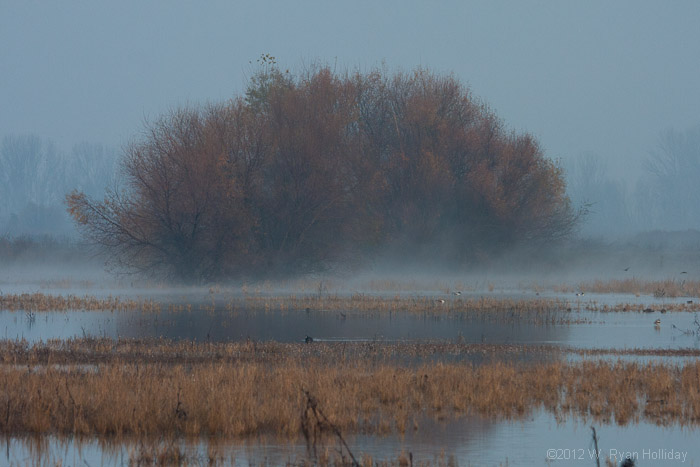
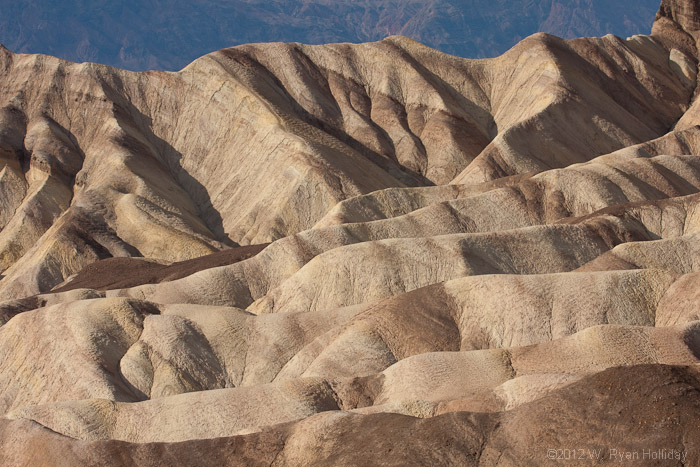
The recent journal entries have lacked in pretty pictures, so before boring my twos of readers with yet another verbose saga about the life of Holliday, here are a couple of pretty pictures from the December roadtrip. The first was taken early in the morning fog at Merced National Wildlife Refuge prior to a massive breakfast, while the second is from an afternoon in Death Valley.

Foggy Landscape in Merced NWR

Foggy Landscape in Merced NWR.

Foggy Landscape in Merced NWR

Zabriskie Point in Death Valley National Park.

The Plan

Posted from Boise, Idaho at 6:35 pm, January 31st, 2013

This journal entry has gone through a few drafts. What started out as a retrospective on my changing goals in life (quick summary: at age five it was to become a superhero, and at age 37 I’m still trying to figure it out) turned to thoughts of how much of a legacy people actually leave. In thinking about this topic, it seems that a “legacy” is often evaluated based at least partially on luck. Consider someone like Steve Jobs – he was clearly a visionary, he obviously changed the world, and like almost any successful person this was due to a combination of hard work, determination, and intelligence. However, had he stayed at Reed College, or had his first venture into personal computing failed, the name “Steve Jobs” might mean nothing to us today. He undoubtedly still would have lived a notable life, but a man who is today universally revered as a visionary would not have been known to the world at large. In no way do I want to diminish the impact of someone like Apple’s former CEO, but it’s an interesting thought to realize that people you view as having “left a legacy” are often just one or two accomplishments away from relative obscurity.

If a lasting legacy requires at least a small amount of luck, it is also true that a far larger amount of perseverance, hard work, intelligence, and ability to seize opportunities is required. Thus, while it might be a disappointment to my five year old self to discover that his older counterpart lives a happy but relatively un-notable life, the older version of that superhero-wannabe is able to take some pride in still trying to achieve great things, and still making an effort to leave a positive mark on the world. Simple math shows that most people will not make a significant impact on humanity, but it is only those who continue to strive that have any chance of successfully doing so.

2013 Predictions

Posted from Culver City, California at 9:07 pm, January 12th, 2013

Year five of the prediction game is ready for publication. For those keeping track of the steaming pile that is the past year’s predictions, they can be found at the following links: 2009, 2010, 2011, and 2012.

  1. The resolution to the current debt ceiling debate will permanently defuse the debt ceiling as a future threat. Either Obama will simply ignore the debt ceiling since he either breaks the law by breaching the debt ceiling or he breaks the law and tanks the global economy by adhering to the debt ceiling and not spending money Congress budgeted, or else legislators will compromise on something like the McConnell Plan so that future debt ceiling fights become purely symbolic exercises. With regards to the current debate, West Virginia Senator Joe Manchin summed it up well when he said “Something has gone terribly wrong when the biggest threat to our American economy is the American Congress.”
  2. Usain Bolt will not win an individual gold medal at the 2013 Track & Field World Championships and will be overshadowed by his training partner Yohan Blake who will win both the 100m and 200m.
  3. A la carte cable, in which consumers can choose only the channels (or even the shows) they want, will be announced (or on the verge of reality) from one or more companies capable of making it happen for the vast majority of America. Whether it’s Apple allowing people to get HBO and other channels via an internet-connected box, Google striking some deal, or another major player, the cable companies’ lock on programming bundles will begin to crack soon.
  4. The unemployment rate will drop from its current rate of 7.9% to around 7.3% (+/- 0.1%). It was 8.3% one year ago, so this would represent a continued gradual improvement to economic conditions.
  5. With Washington and Colorado having legalized marijuana, there will be a push at the national level to either reduce penalties for marijuana or to give states greater flexibility. Right now marijuana is completely illegal at the federal level but legal for medical or other purposes in a number of states. Since federal law trumps state law, this year will see efforts to provide some clarity to the issue.
  6. With agreements in place for the construction of the Farmers Field sports complex in downtown LA, the NFL will announce a deal to bring a football team to the city. There seems to be a number of reasons why LA won’t get a team this year, but with a stadium project approved it seems hard to believe that the powers-that-be won’t find a way to get a team in America’s second-largest television market.
  7. Star Trek Into Darkness, Hunger Games: Catching Fire, and Man of Steel will be three of the five highest grossing movies of the year. They absolutely must make a kickass Superman movie.
  8. The next iPhone will offer the same form factor as the current iPhone 5, but will add the ability to use the phone for credit-card-like payments using near-field communication (NFC). The most recent software update added Apple Passbook, which seems like an oddly limited feature and suggests that something more is planned.
  9. Increased demand for the Model-S will cause Tesla to increase its production target for 2013 from 20,000 vehicles to at least 30,000. As its many awards and enthusiastic user reviews demonstrate, this car is going to be extremely popular, and Tesla will find it in its best interests to try to more quickly meet a growing demand.
  10. Congress will not pass significant immigration reform this year. Immediately after the election Republicans softened their stance on immigration, and this seems to be an area where the two parties might actually try to get something done, but I suspect that the politics of the issue are such that passage will be more likely after next year’s primary elections, when GOP members are less likely to fear a primary challenge from their right flanks and more anxious to gain favor with moderates.
  11. At least one of the following companies will not survive the year: Sears, J. C. Penney, or K-Mart (note: owned by Sears). I remember how strange it seemed when Montgomery Ward, a fixture of the retail world for 129 years, disappeared in 2001, and I suspect that this year may claim another iconic retailer who hasn’t adapted well to the internet age.
  12. Spacex will carry out 4-5 launches of its Falcon rocket (they have at least six planned) and one successful test launch of their massive new Falcon Heavy rocket. How awesome is it to live in a time when you can make predictions about rocketships that actually have a chance of coming true?!?!?
  13. California High-Speed Rail will break ground in the Central Valley as scheduled this year. Critics say that this is a government boondoggle, and they may be right, but high-speed passenger rail is still a good idea for the state’s future.
  14. Jinxes are real, so this is a prediction I shouldn’t make, but the Browns will have a winning record in 2013. The team was better than the 5-11 record indicates this year, and they’ve not only got a pretty good young roster, but they’ve got a high draft position that should translate into an even better group of players for next year. And yes, this is the type of prediction Browns fans make every single year, and are wrong about every single year.

The comments link is available for anyone who wants to add their own predictions. Alternately, while it may still be early in the year, feel free to begin mocking these likely-incorrect conjectures now.

2012 Prediction Scorecard

Posted from Culver City, California at 9:21 pm, January 9th, 2013

To review the sad four year history of my annual predictions, here’s the past scorecard: 2009: 31% correct (5 of 16), 2010: 44% correct (7.5 of 17), and 2011: 50% correct (7 of 14). With that out of the way, here’s the review of 2012:

  1. Obama will win re-election with no fewer than 320 electoral college votes in 2012.

    Obama 332, Romney 206. Score one for rholliday, but it’s downhill from here.

  2. Democrats will lose 1-3 Senate seats.

    When I made this prediction Democrats were projected to lose five seats, but between unfortunate rape comments and surprises in Montana and South Dakota they actually picked up two seats. Maybe it should count that my incorrect guess was less incorrect than the political scientists?

  3. Democrats will gain 15 seats (+/-5) in the House.

    Despite getting 49.2 percent of the votes (versus 48.0 percent for the Republicans) Democrats only picked up eight seats and remain in the minority.

  4. Tesla Motors will begin deliveries of the Model-S during July/August and will receive excellent reviews and heavy sales. They will not meet their delivery target of 7,000 vehicles for the year, but things will look good for them going into 2013.

    Deliveries started in the summer, about 3000 cars were delivered by year’s end, and so long as Motor Trend Car of the Year counts as an “excellent review”, this is my second correct prediction.

  5. American men’s distance runners will win 2-3 medals (out of nine available) in the 1500, 5,000 and 10,000 meters at the London Olympics.

    Galen Rupp took silver in the 10,000, becoming the first American since Billy Mills in 1964 to medal in that event. In the 1500 Leo Manzano roared past a number of bigger names in the final stretch to grab a silver. The prediction scorecard rises to three-out-of-five before launching into a steep nosedive.

  6. Following the Arab Spring of 2011, 2012 will see change spread to Iran.

    Not a peep out of that part of the Middle East this year. A spectacularly wrong prediction.

  7. The long rumored Apple television will finally launch in 2012.

    I’ve been predicting an Apple television every year since 2010, and I’ve been wrong every year since 2010.

  8. Despite a handful of analysts predicting doom, the Euro will easily survive 2012, and 2012 will see centralized European institutions strengthened.

    After fears in 2011 that Europe would literally explode into a cloud of ash and dust that smelled faintly of spanakopita, things calmed down significantly in 2012. In terms of “strengthening central institutions”, the ECB emerged as a more powerful force, but overall this is a half-credit prediction.

  9. The Browns will not draft Andrew Luck or Robert Griffin III.

    They didn’t draft either player, but if Washington hadn’t traded a ridiculous number of first round draft picks then the Browns would have given away almost everything to make RG3 wear orange. While technically I was right, based on the spirit of the prediction add one more to the “incorrect” column.

  10. Virgin Galactic’s space plane will have several successful test flights by the end of 2012. SpaceX will successfully launch two missions to the ISS but will not launch the Falcon Heavy as currently scheduled on their launch manifest.

    It hurts me not to get the spaceship prediction one hundred percent correct. SpaceX had a great year, sending two flights to the ISS and moving ahead with a bunch of exciting new upgrades. Virgin Galactic has been more of a mystery, with a few drop tests but no rocket-powered flights.

  11. Neither the Supreme Court nor Congress will do anything to meaningfully affect Obamacare.

    While there was a great deal of uncertainty leading up to the Supreme Court ruling, in the end it only added some limitations to Medicaid and the healthcare law is moving forward as designed.

  12. The Dow Jones will finish the year near 13,000.

    The Dow closed the year at 13,104. Somehow, despite a horrid record of predictions I’ve guessed the stock market close correctly three out of the three times I’ve tried. Because jinxes are real, there will be no prediction on this topic for 2013.

  13. Tiger Woods will have an exciting 2012, winning 1-2 majors and 4-6 tournaments.

    Tiger won three tournaments but no majors. While that’s an insanely great year for most golfers, it’s not stellar by the standards Woods set earlier in his career. The prediction scorecard again dips into the red with six correct and seven incorrect.

  14. Hollywood will announce that they are re-making at least one of the following five movies: Grease, It’s a Wonderful Life, Spartacus, Jason and the Argonauts, or Butch Cassidy and the Sundance Kid.

    Not even close. It’s probably a good thing that we’re not living in a world where the Twilight kid ends up playing Danny Zuko.

  15. Either Yahoo or AOL, or both, will not survive 2012.

    After making a prediction that Yahoo would go away every year since 2009, I’m not predicting anything about these companies ever again. How both Yahoo and AOL still exist is a mystery to me.

Final score: 40% (6 of 15). While this score doesn’t beat 2009’s record for futility, it does stand as a mark that should embarrass and shame the prognosticator. However, all shaming aside, I feel confident in stating that the upcoming predictions for 2013 will challenge 2009 in the record books. Stay tuned.

The Valley of Death, Part II

Posted from Lancaster, California at 8:53 pm, December 30th, 2012

I hiked a couple of miles out into the Badwater salt flats early this morning, sat down in the snow-white crystals of a dried up salt pool, and the desolation was glorious.

After a good night’s rest the morning featured some sunrise photography, a hike through the Badwater salt flats, and a delicious burger for a hungry boy. Post-burger the itinerary included a visit to the yellow formations of Zabriskie Point, and a drive up to Dante’s View. I thought I’d been to this overlook before, but I don’t remember it, and it’s a memorable spot with a five thousand foot sheer drop down to the valley floor and a ridiculously great view of the awesome geology of the surrounding landscape – since that’s three superlatives, odds are that my memory is faulty and this is a spot that has not been on a past trip itinerary.

After leaving Dante’s View the trail led towards home via the eastern Sierra, with a brief stop to enjoy the Milky Way, and the current stop to try to get a journal entry written before it gets too late (aka 9PM) and my brain starts getting mushier than normal. Tonight will be spent in a real bed as this end-of-year trip sadly comes to its end.

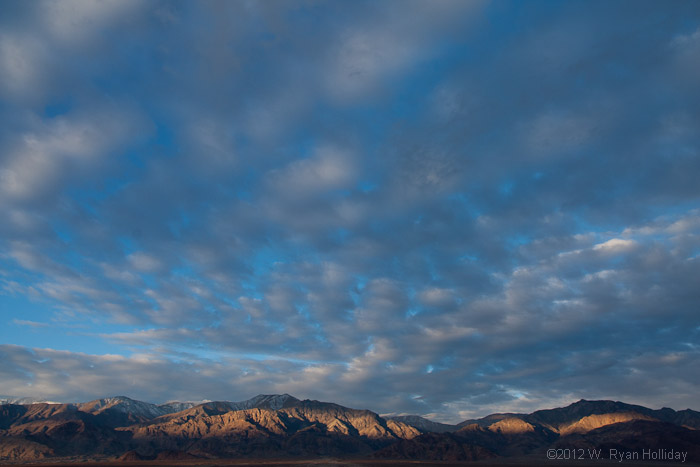
Badwater Basin Sunrise

Badwater Basin sunrise. The color on the mountains was also impressive, although you wouldn’t know it from the pictures I took.

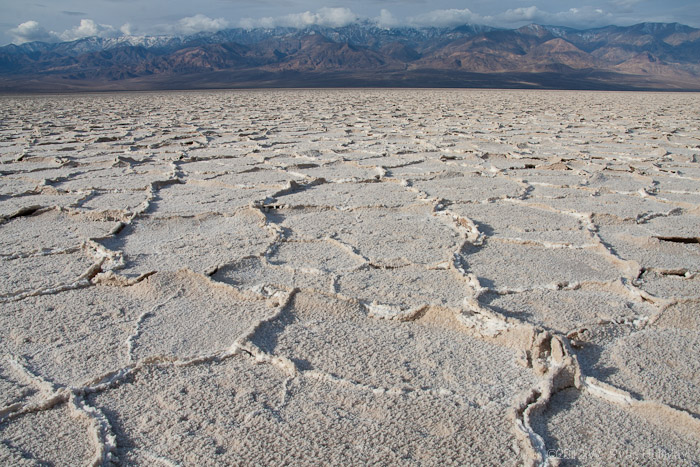
Badwater Basin Salt Flats

Badwater Basin salt flats. See all the people? No? Glorious!

The Valley of Death

Posted from Above Badwater Basin, Death Valley National Park, California at 7:08 pm, December 29th, 2012

Some thoughts from today:

  • There is all kinds of cool stuff happening in the desert town of Mojave. Scaled Composites (the first private company to put a man in space) is there, along with Virgin Galactic and all manner of other cutting edge aerospace companies.
  • Off roading is apparently a much bigger deal than I realized. While roaming dirt roads in the desert I passed hundreds of RVs organized into camps of 5-20 vehicles, each camp home to dozens of ATVs and dirt bikes. One of the RVs in every camp was always flying a giant flag, and I’m gonna go out on a limb and say that these same folks show up in force for Nascar.
  • The craggy, primordial landscapes in the deserts of the Eastern Sierra are the types that require the internal narrator to assume a deep voice and say things like “and thus did God create the EARTH”, with backing music from a booming timpani drum. Driving through this area, it really does feel like this is how the Earth looked a couple billion years ago.
  • Despite many past visits to Death Valley the Wildrose portion of the park is somewhere I’d never been before today. That part of the park is at a higher elevation and featured a bit of snow, along with a landscape through tiny canyons and vistas that kept making me think how crazy it was that they even built a road here. This area is now officially Ryan approved.
  • I debated spending the night car camping in the campground at Furnace Creek, but instead of spending the evening wedged between RVs I decided to haul the Suby a few miles up a “road” (*cough* rocky gully *cough*) and am camped for the evening with a view that includes the entire Badwater Basin and has no neighbors. Provided I don’t wake up in the morning with one or more flat tires this appears to be a far better sleeping option.

A Day at the Refuge

Posted from near Buttonwillow, California at 7:39 pm, December 28th, 2012

In the 1800s there was wetland from Sacramento to Bakersfield, and a person could travel the entire route by boat. Today ninety-five percent of that has been converted to farmland or cities, so one can only imagine how insanely awesome the wildlife must once have been.

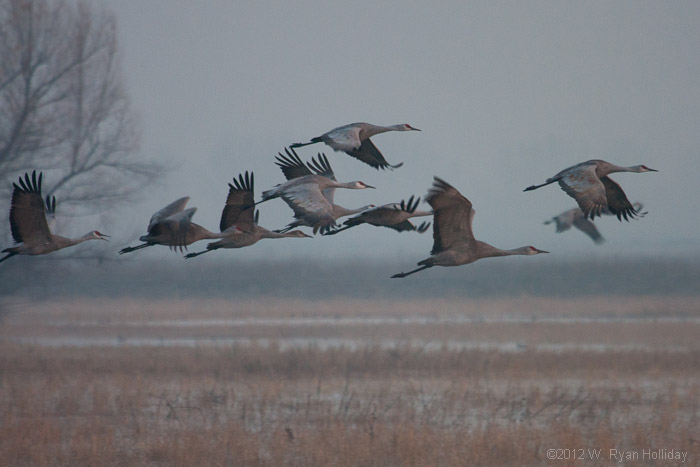
Wakeup was at 6AM to catch sunrise at the Merced NWR and to hopefully see the cranes before they dispersed for the day. It was ridiculously foggy, but the calls of several hundred cranes helped with locating the birds and I managed to grab a few shots as they departed to their favorite breakfast spots. Unfortunately the elusive “money shot” was not to be had today, so a crane photo remains on the bucket list.

The entire day was spent at the refuge, with a brief intermission to eat a massive biscuit and take a shower. Hawks, herons, and a few thousand snow geese were among the day’s other sights – if what I saw represents five percent of the historic abundance, the Central Valley must have been a wonder in its wildlife prime. Tonight will most likely again be spent sleeping in the glorious confines of the Subaru, with tomorrow’s plan (subject to change) being to meander along a route to Death Valley that I’ve never tried before.

Sandhill cranes at sunrise

A flock of about two hundred cranes dispersed in a matter of minutes when the sun came up, making for a frantic and fun photo shoot.

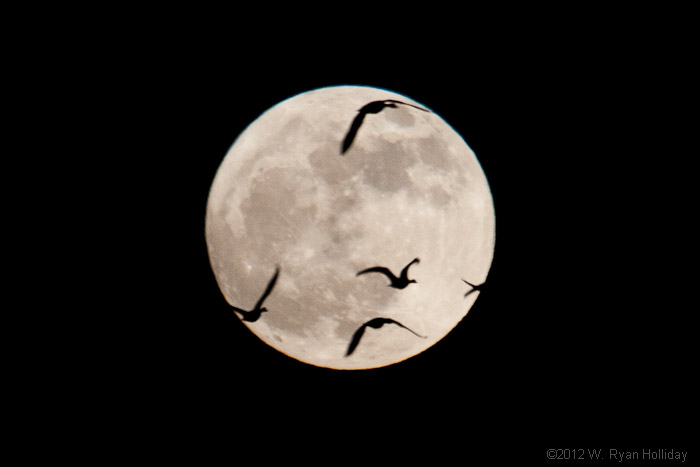
White-fronted geese and the full moon

A shot from yesterday of white-fronted geese flying past the full moon. I thought this was a neat shot although perhaps a bit too odd for the journal, but Audrey gave her approval.

Several Thousand Geese-a-Flying

Posted from Merced, California at 10:06 pm, December 27th, 2012

After a bird-themed Christmas, waffles, a game involving trains (a recurring activity this holiday season, apparently), and hiking in the mud with Aaron I took leave of Ma & Pa’s house and returned to the road. Today’s stop was at the Cosumnes River Preserve, home to (literally) tens of thousands of geese and numerous other feathered critters. Having flocks of thousands of geese and the occasional sandhill crane passing overhead as the sun set was not a bad way to finish the day.

Several thousand white-fronted geese take to the skies as the sun sets. Turn up the volume for maximum enjoyment.

Chasing Cranes

Posted from Concord, California at 10:46 pm, December 24th, 2012

Last night was spent sleeping in the back of the car on the side of the road. It felt good to be a vagabond again.

Today’s adventure was a tour of several wildlife refuges to scout possible locations for the sandhill crane picture that has eluded me for so long. While the birds were again uncooperative, there’s hope. The morning’s first visit was to Merced National Wildlife Refuge, home to a ridiculous number of cranes and the new number one contender on the crane photography list. Arrival was too late for good light, but this is a place that will be re-visited.

The second planned stop was the San Luis National Wildlife Refuge, but Apple’s new map tool calculated a route that went from sketchy country road to potholed mess to muddy quagmire. I was skidding all over the place, tearing up clay, doing my best to avoid sliding into the irrigation ditch next to the road without reducing speed to the point where I’d get trapped in the muck. When eventually I found a place wide enough to turn around I was absolutely positive that the car would get stuck, but a Christmas miracle occurred and the Suby dug its way out and I escaped without a call to AAA. After this mini adventure there were disconcerting squealing noises coming from the front of the vehicle, so I headed to the nearest town where it took a full twelve minutes of power washing to get all of the clay/mud out of the wheel wells and axles.

After finding a new route that followed actual roads I arrived at San Luis NWR, which was scenic, as was the day’s final stop at the Isenberg Crane Reserve. However, Merced NWR was clearly the winner and a spot that will see another visit on the post-Christmas trip. In the interim the plan calls for spending a couple of days at Ma & Pa’s for the annual family Christmas, feasting, and misadventures with my brother.

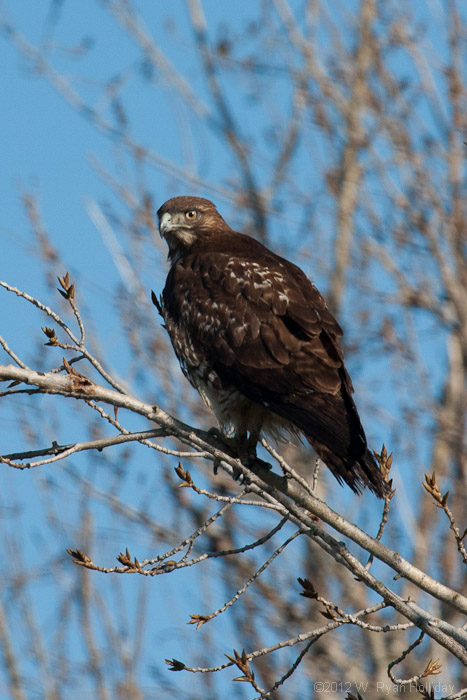
Red-tailed hawk at Merced National Wildlife Refuge

Red-tailed hawk at Merced National Wildlife Refuge. My copy of the Sibley guide is at home, so I’m basing this identification on the fact that I generally assume all big hawks are red-tails.

The Hoya

Posted from Culver City, California at 10:07 am, December 23rd, 2012

As of the 21st I have twelve glorious, work-free days. Life is quite good at the moment.

To start the vacation extravaganza Audrey and I went down to San Diego to greet the Mayan end of the world with her sister, mom, and mother’s husband. We drove down Thursday night, woke up to find the world still in existence Friday morning, then roamed La Jolla for a bit before joining her family members for lounging and steak in a three bedroom bungalow at the very cool (both figuratively and literally) Lafayette boutique Hotel. There was a game involving dominoes and Mexican trains that I confess to not fully understanding, a broken heater, a hairy cousin, and plenty of other shenanigans to make for a fun journey.

Tonight will begin the annual holiday trip, with a few nature stops planned before a Christmas spectacular with the family in Concord, followed by the annual post-Christmas road trip – there should be much car camping, early rising, and random journeying to end the year.

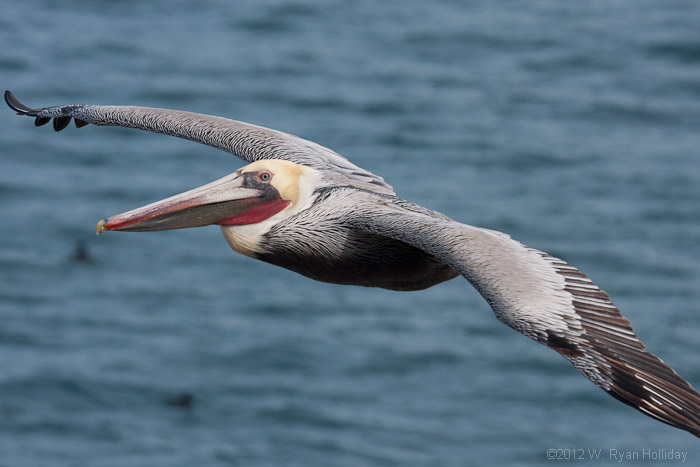
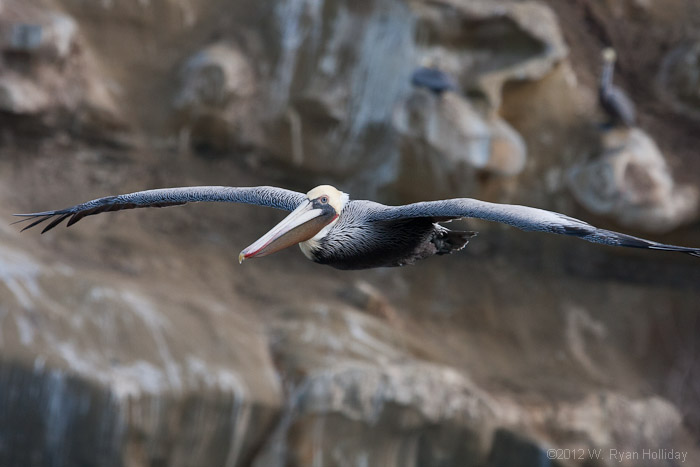
Brown pelican in La Jolla

Brown pelican in La Jolla. This was one of the few birds who agreed to stay in focus and in frame.

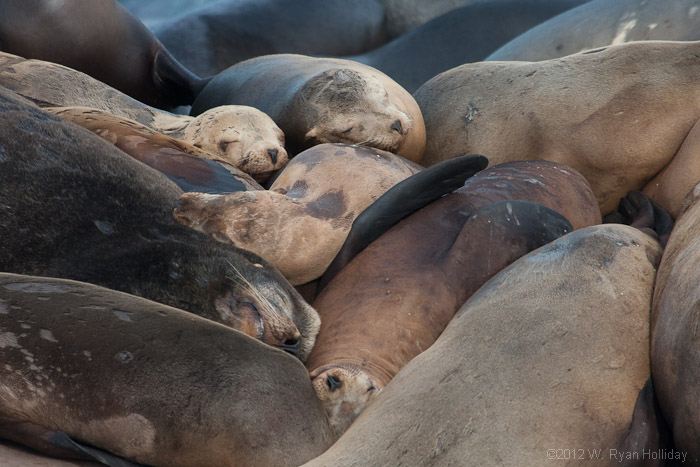
Sea Lions in La Jolla

Pile o’ sea lions in La Jolla. Despite the fact that this may look like a morbid heap of deceased pinniped, all of these guys were very much alive.

Brown pelican in La Jolla

Money shot.

The Giving of the Thanks

Posted from Culver City, California at 5:31 pm, November 30th, 2012

This year’s Thanksgiving saw Audrey and I make our annual trek through traffic and up to Ma & Pa’s residence in the Bay Area, arriving Wednesday night with pies (plural) in hand after more than seven hours on the road. Aaron is again living in the Bay Area and working at Nordstrom, and by “living in the Bay Area” I mean “living with my parents” and doing so by choice since economics are not really an issue. Dolphins and parrots supposedly stay in family units for years and years, so younger Holliday’s living arrangement is apparently not without precedent.

Aaron and I set off on a muddy hike up Mount Diablo on Thanksgiving morning, saw two flocks of wild turkeys on the trip home, ate the world’s largest biscuit, and then joined everyone else in lounging the day away before eating massive quantities for dinner. The following day Audrey and I were off to meet her best friend Krissy in Moss Beach, with a stop along the way in the Marin Headlands to fight for parking and enjoy a view of the Golden Gate. The next morning Krissy took us up into the hills to hike amongst big trees and banana slugs before a very tired pair made the long journey back to LA.

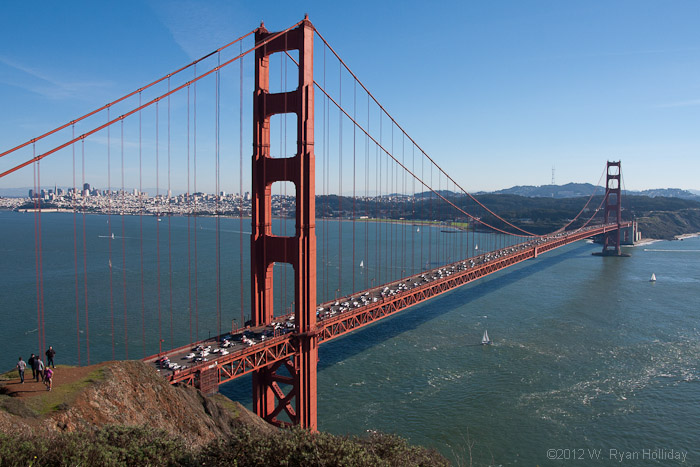
Golden Gate Bridge from the Marin Headlands

Golden Gate Bridge from the Marin Headlands.

Scared the Children

Posted from Culver City, California at 10:37 am, November 25th, 2012

When I first met Audrey it was literally a matter of minutes before she started telling me about Scare the Children, her annual Halloween haunted house. The 2005 event was the only one I’ve ever participated in, although there was a long and proud tradition that went on for many years before it that had to be put on hiatus when we moved to a townhouse. Now that we own our own house, warnings were sent to the neighbors, streetlights were blacked out, and a small army of volunteers descended to help build platforms in trees, rig up fog machines, and otherwise convert our sweet abode into a scene from an Edgar Allan Poe story.

My main role in the setup was in helping Audrey procure a casket – yes, somehow I’m in a relationship with a girl who owns a casket. Audrey found one on Craigslist, the backstory checked out enough that we were confident the seller hadn’t procured it with a shovel and some late-night trespassing, and I found myself in the unusual position of loading a metal coffin into the back of the Subaru. Audrey was happy because she now has a centerpiece for her Halloween craziness, and I now feel confident that she won’t be able to argue should I ever decide I want a lifesize Han Solo in carbonite for my room.

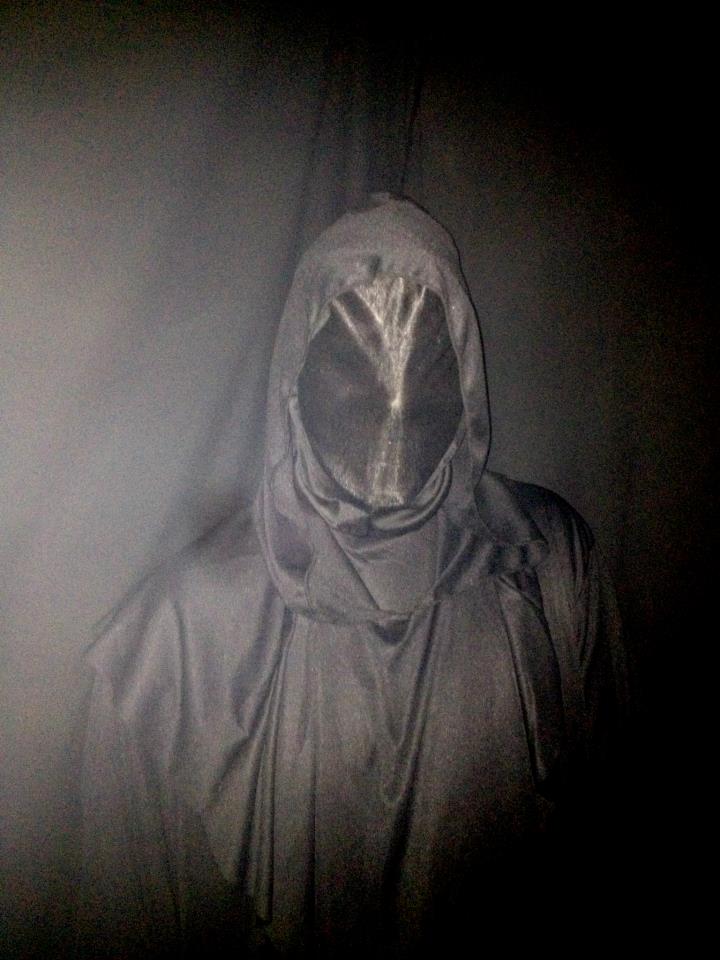
Audrey’s preparation and hard work paid off on Halloween night, with about a hundred young visitors in varying states of terror. My role in the extravaganza was to stand near our front door, which we had enclosed in black fabric, while wearing all black. No one could see me, so I’d wait until they got candy and then growl at them as they turned around; kids screamed and parents yelled some things that may not have been appropriate for children’s ears. Other highlights included Nancy in the coffin, Shelly in a tree, Pete with chains and strobes on the side of the house, and Stephanie as a witch sitting in the corner of the yard while controlling a snake on a string that jumped out at people. The following day our eighty-plus year old Japanese neighbor, who has always been very quiet and seemed somewhat suspicious of the oddballs next door, came over and noted “Good job. I like that snake.”

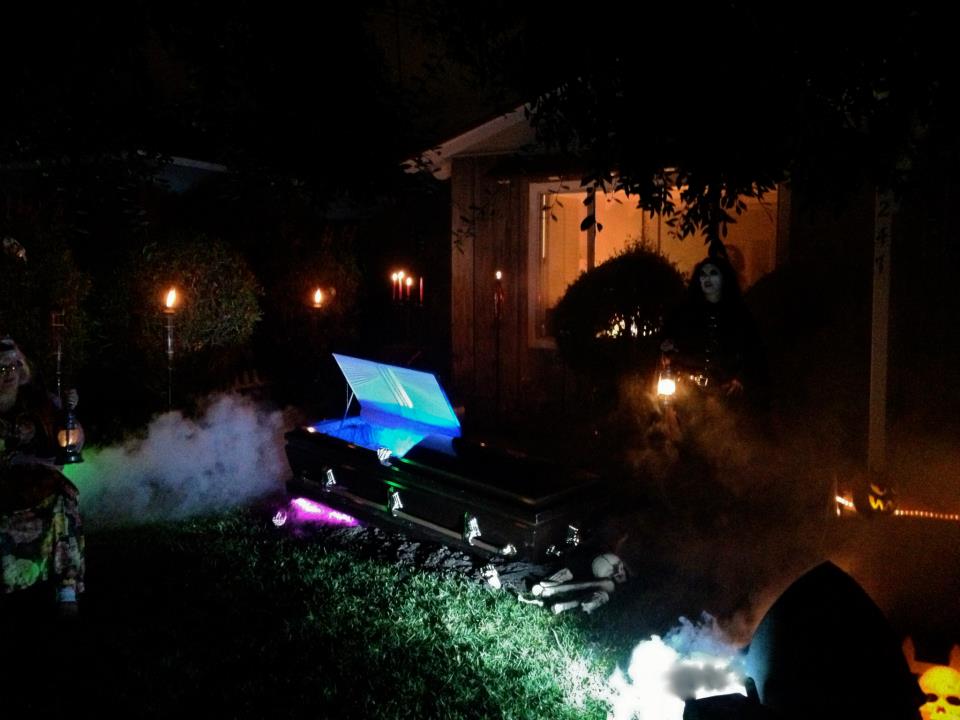
Yard

Scare the Children in action. Photo by Audrey

Gina

Gina, an experienced child scarer. Photo by Audrey

Ryan

I was completely invisible without a massive amount of light, and quickly discovered that a quiet growl six inches away from a parent’s ear was generally enough to get them to scream out things that they might not normally yell around children. Photo by Audrey

Election 2012

Posted from Culver City, California at 5:38 pm, November 11th, 2012

While politics is a bit of a dangerous subject to bring up in a public forum these days, it would be a shame not to record a journal entry for posterity about the election, so here are some (hopefully) non-partisan thoughts on the recent election. The comments link is available for anyone who would like to berate me, berate the parties, or add their own thoughtful and nuanced musings.

  • Obama won the electoral college 332-206 and the popular vote 51-48. While this is a big win relative to recent Presidential elections, pundits who are predicting a permanent Republican minority due to demographic changes might want to tone it down – if merely two voters out of every hundred had a change of heart the storyline would instead be about the failings of the Democratic party, and as the once-solidly Democratic Southern states demonstrate, demographic groups can completely flip their party alignment over time.
  • In a story that isn’t getting much press, the Democrats shocking gained two Senate seats in a year in which they had 23 seats up for re-election (vs 10 for Republicans), increasing their Senate majority from 53-47 to 55-45 and winning in places like South Dakota, Missouri, Montana and Indiana. As a result, it seems much more likely that the Democrats will now be more confident about their odds of keeping the Senate in 2014 (when they have six seats up in states that will be very difficult to retain), and thus will change Senate rules to limit use of the filibuster, thereby making it much easier to confirm Presidential nominees and bring bills to the floor for discussion. While the ability to filibuster a vote (ala Jimmy Stewart in Mr. Smith Goes to Washington) is unlikely to be changed, filibustering every motion to move a bill forward will likely soon be a thing of the past.
  • The following issues that affect people on a day-to-day basis are now almost certain to happen as a result of this election: Obamacare is going to be fully implemented, EPA fuel efficiency rules (fleet averages of 54.5 mpg by 2025) and efforts to limit CO2 emissions will continue, tax rates on income over $250,000 are going up, and the Supreme Court will not become more conservative.
  • On a less-certain note, Republicans have split over immigration in the past – George W. Bush pushed for immigration reform in order to attract Hispanic voters, while Mitt Romney was in favor of self-deportation as a play for Republican base voters. Based on recent statements, Republicans seem to have taken the election results to mean that the pro-immigration voices in the party were right, so it would be a good bet that comprehensive immigration reform becomes law by 2014.
  • Andrew Sullivan made the argument that those who categorized this election as a choice between freedom and tyranny would be well-served by re-evaluating their assumptions (this argument applies to both sides). To be very clear: neither Obama, nor George W. Bush before him, want to destroy America. The two sides simply differ on policy and the role of government, and those who choose to demonize either side as evil or anti-American make it much more difficult for the parties to work together since there is no way to justify compromising or finding common ground with someone who actually wants to destroy the country.
  • Finally, despite wild speculations from various pundits, for the second Presidential election in a row Nate Silver and his poll aggregation model was the one who most accurately predicted the election results. To this engineering grad, no matter which side wins, vindication of a math and statistics approach over hand-waving and demagoguery is a good thing.

2032

Posted from Culver City, California at 8:00 pm, October 24th, 2012

Despite being horrid at it, journal entries that make predictions about the future are some of my favorites to write. Thus, in keeping with a long and embarrassing tradition of ignoring better judgment and making uninformed guesses about the future, here are some thoughts about trends that might develop over the next twenty years.

To provide some perspective, think back twenty years to 1992. At that time most people didn’t know what the internet was. Pagers were the best way of contacting someone and cell phones were still almost a decade away from becoming ubiquitious. CGI was still a rarity in film, and it would be another year before Jurassic Park would stun the world with dinosaurs that were not filmed using robots or stop motion. Global warming was still an obscure theory that only a handful of climate scientists (and Al Gore) had even heard about. Even though predictions about today’s world made in 1992 would have likely been as wrong as the flying car and nuclear-powered dishwasher predictions made in 1950s science magazines, it’s still fun to make an attempt to speculate on developments over the next twenty years.

Energy

Two specific developments might vastly change energy: batteries and decentralized power generation. Currently energy can be generated, but it is hugely difficult to store efficiently and thus must be used immediately. With batteries becoming approximately eight percent more efficient each year, and assuming my math is correct, in twenty years they’ll be about five times more efficient and likely significantly cheaper. Today’s best batteries can power a car for 300 miles, so in twenty years that same battery would theoretically allow 1500 miles of range; with that kind of storage almost all non-electric motors (which are less efficient) would become obsolete, and more generally energy would move from something that must be produced on-demand into an entirely new paradigm. In addition, renewable sources like solar are also improving rapidly. Today, in places with lots of sun, solar is cost-competitive with grid electricity. Assuming a 4-5x improvement in the next two decades, combined with efficient batteries that can store energy for usage when the sun isn’t shining, and suddenly it would be more economical for individual households and businesses to have solar panels than to not have them. If that happens then usage of decentralized power skyrockets, and reliance on huge, centralized coal, oil and gas power plants (and the corresponding pollution they generate) diminishes greatly. As a wildcard, at some point (be it in ten years or a hundred) research into fusion and superconductors will yield breakthroughs that will result in essentially limitless, super-cheap, pollution-free energy.

Bionics

Bionics is something that sounds scary until you realize it is already happening. Today people think nothing of pacemakers or hearing aids, and almost everyone has a cell phone that they carry at all times to keep connected to everyone else. The process of melding humans and machines is already well underway, and will only continue. In the next twenty years technology will probably become available to make bionics even more personal, including capabilities such as the ability to project a screen directly onto the retina, thus moving the functionality of a cell phone from a device in your hand to something that is actually inside of your head. With increased processing and networking speeds, having an infinite amount of data about the world projected directly into your field of vision will no doubt revolutionize how people interract with one another.

“Thinking” computers

When a person is trying to solve a problem they gather all available information, analyze it, weigh things appropriately, and then make a choice. If that choice turns out to be incorrect they can gather more data, change how existing data is weighed, or otherwise modify their thinking to make a better decision. Currently computers are far better than humans when it comes to analyzing input given a specific set of rules and data, but they aren’t good at modifying those rules or gathering more data; that’s going to change at some point in the future, and when computers can begin analyzing and solving complex problems it will have massive repercussions for quickly advancing knowledge in fields ranging from economics to politics, and especially in all facets of scientific research.

Medical advances

People often lament that medicine hasn’t cured any major disease since eradicating polio, but the medical field may be on the verge of huge advances using stem cells, or cells with properties similar to stem cells. Today if you have nerve damage (such as a spinal cord injury) there is little or nothing that can be done about it, but stem cells offer the potential to simply use your body’s existing genetic blueprints to “fix” the damage. Similar processes could be possible for creating new tissues, thus eliminating the need for organ or blood donations. These breakthroughs would affect all manner of other health and medical issues, so assuming the technology continues to advance, everything from joint pain to amputation could become as anachronous as polio is today.