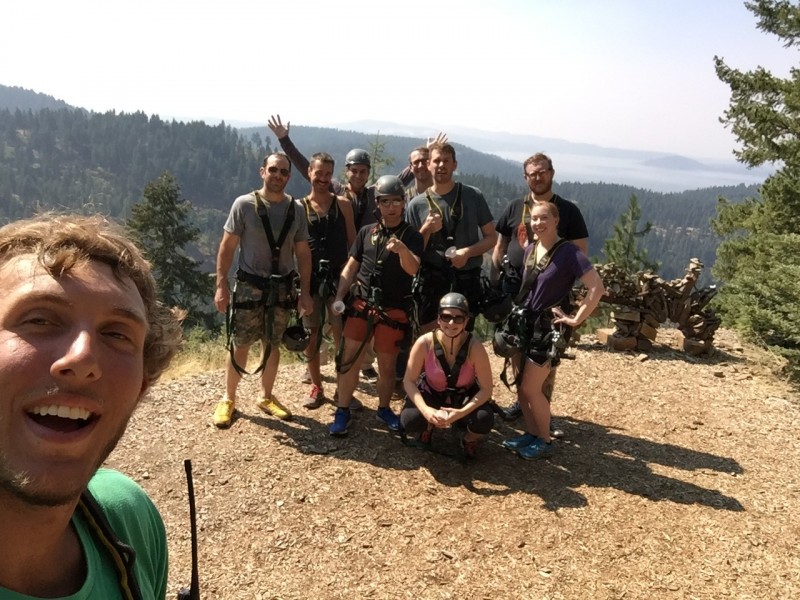
It’s been too long without photos in the journal, so here are a couple from the 2014 safari in Tanzania that didn’t previously make it online:


"My life amounts to no more than one drop in a limitless ocean. Yet what is any ocean, but a multitude of drops?" — David Mitchell
It’s been too long without photos in the journal, so here are a couple from the 2014 safari in Tanzania that didn’t previously make it online:


I’m not sure if this subject has made it into a journal entry in the past or not, but my favorite theory of why America remains such a powerful force in the world seems like a good topic for a Fourth of July entry.
During my four decades of life it has been a common refrain that the US is on the decline and in danger of losing its position as the world’s leader in commerce and innovation. In the 1980s and 1990s it was seen as inevitable that Japan would soon take the lead position, and these days everyone seems to believe that China will do so. Yet somehow, despite falling behind in metrics like education, government investment, etc, the US still creates companies like Tesla, Google and Apple that lead the world.
A theory that I read a long while back is that the root of America’s success is literally encoded in our DNA – being unique as a nation of immigrants, nearly every citizen has in their family tree the DNA of someone who was motivated to leave their circumstances and go to a country where, if they worked hard, they could create a better life. In an evolutionary sense, the entire country is made up of people whose gene pool favors motivation, hard-work, and risk taking. As a result, in America if you create a business that fails, instead of being demeaned for failing you are rewarded for having tried. If a city declines and jobs disappear people don’t sit around and wait for improvement, but instead pack up and move to another city that offers better prospects. When an individual wants to follow a dream, it isn’t considered crazy for them to sell prized possessions or amass large debts in order to fund that dream and make it become reality.
There are of course a vast number of exceptions to the above examples, but moreso than any other country, Americans can be characterized by traits that trace back to ancestors who risked everything to come to a new place that offered hope of a better life. Furthermore, that hope wasn’t represented by the prospect of an easy life, but was instead based on a belief that hard work would be rewarded. On this Fourth of July I like to believe that the greatness of America might literally be encoded in the DNA of its citizens, a fact that makes me optimistic that, despite its stumbles, the success of this nation will continue.
June has been a slow month, but here’s a quick recap:
When I started this journal fifteen years ago the idea of reading a web page on a phone was still magic wizardry reserved for Captain Kirk and Mr. Spock, but in 2017 (actually, starting in about 2007…) wasting horizontal space with three columns is a design faux pas of the highest order. Thus, tonight I spent some time bringing the journal into the mobile age, and the site is now a svelte two columns, with some additional plumbing done to hopefully make the font more readable on small screens, and to allow the images to dynamically resize. While I’m a decent programmer, I have the aesthetic abilities of a blind trout, so suggested improvements are welcome, and if anything seems broken please let me know what browser you’re using and what problem you’re seeing and I’ll try to get it fixed.
Several weeks ago I decided that one of this month’s journal entries would be about why I’m optimistic that the problem of climate change is one that the world is going to solve, and the recent announcement from Trump that the US would join Syria and Nicaragua as the only nations not to be a part of the Paris Climate accords makes the subject even more appropriate.
To greatly oversimplify the issue of climate change, solving it means that clean energy needs to be a better option than fossil fuels in terms of cost and reliability. Looking at trendlines for both metrics, it seems that the world is underestimating how soon that tipping point is going to arrive.
Cost
In terms of cost, consider the following:
The health benefits of reducing air pollution from fossil fuels are an indirect cost, but according to the US Department of Energy:
Achieving the SunShot-level solar deployment targets — 14% of U.S. electricity demand met by solar in 2030 and 27% in 2050 — could reduce cumulative power-sector GHG emissions by 10% between 2015 and 2050, resulting in savings of $238–$252 billion… This could produce $167 billion in savings from lower future health and environmental damages, or 1.4¢/kWh-solar — while also preventing 25,000–59,000 premature deaths.
Reliability
From the standpoint of reliability, the fatal flaw for renewable energy is that it’s only available when the sun is shining or the wind is blowing, but cheap batteries allow renewable energy to be stored and used whenever needed, and they also provide huge benefits for the grid. Since its inception the electrical grid has required energy to be used as soon as it is produced, so grid operators have had to execute a complex process for matching output to demand, and also have had to ensure that enough generation is available to match the highest possible load, meaning some power plants exist solely to meet demand on those few summer days when everyone is running their air conditioners. As batteries get cheaper, suddenly that’s no longer the case – instead, you store energy to handle peak loads, generation capacity just has to match average load (so inefficient power plants can be retired), and grid reliability is no longer an issue.
Reliability of cars improve when the system goes electric, too. A gasoline engine is about 20% efficient, the electric motor is closer to 75% efficient. The gasoline engine has belts, pistons, and tons of other moving parts that can fail, the electric motor is essentially a simple shaft wrapped in wires that costs far less to produce. A gasoline car requires a complex, multi-speed transmission, an electric car has a simple, single-speed transmission. A gasoline car uses oil, requires an exhaust system, and has tons of belts and hoses, an electric car has none of those things. Twenty years from now, we’ll wonder why anyone ever put up with regular trips to the mechanic.
Finally, consider home solar. Today we accept that a transformer failure or a fallen tree can mean no power for a few hours, and that a natural disaster can mean power outages for days. However, as solar and batteries drop in price, the grid starts to look kind of crazy – why would anyone pay more to have an unreliable grid connection that requires flimsy high voltage wires to be strung through the neighborhood when a system that can generate power from sunlight and store a few days worth of backup energy is available for the same (or less) money?
Why the future is awesome
The timelines above suggest that within the next twenty years a renewable energy world will beat out fossil fuels on both a cost and reliability basis. Stretch that 30-50 years, and all sorts of interesting possibilities occur – to cite one, desalination is cost-prohibitive because it is energy intensive, but if energy is cheap then a city like Los Angeles, located next to the ocean but forced to import freshwater from hundreds of miles away, could conceivably generate more freshwater than it needs and actually start exporting water to the rest of the state. Citing another interesting possibility, cheap energy might make it feasible to begin scrubbing CO2 from the atmosphere, so not only would emissions drop as fossil fuels are phased out, but mankind could actually begin to forcibly remove some of the greenhouse gases that we’ve unleashed.
Leaving the Paris Accords seems like an unnecessary, self-inflicted wound for the country, but the rate of technological advance still gives me great hope that the problems the world faces are going to be overcome, with or without support from America’s political leadership.

Another month, another recap of that month…

I promise that this will be the last post about the Browns and Moneyball for a while, but with the 2017 NFL Draft now complete (quick summary: from a math perspective, awesome draft by the Browns) I wanted to revisit the 2016 trade of the #2 pick. I get that some people believe that Carson Wentz is going to be the second coming of Peyton Manning, but statistically he seems pretty average so far, and even if he turns out to be above-average, it’s really, really tough to argue with the numbers when you look at what the Browns have gotten for trading that draft pick. Moneyball now and forever.
| Browns trade: | Browns receive: |
|---|---|
|
|
1 via trade with Tennessee for 2016 First Round Pick (#8) & 2016 Sixth Round Pick (#176)
2 via trade with Carolina for 2016 Third Round Pick (#77) & 2016 Fifth Round Pick (#141)
3 via trade with Oakland for 2016 Fourth Round pick (#100)
4 via trade with Houston for 2017 First Round pick (#12)
At 1:48 AM last night, after months of regular visits, the master escape artist and king of all rats was finally caught. I was awoken around 2:30 AM by sounds from above, sleepily got out of bed, got the ladder out of the garage, climbed up to the attic, and finally came eye-to-eye with my nemesis. I brought the cage down to the kitchen, fed him some birdseed as a goodwill offering towards a respected adversary, and then proceeded to spend twenty minutes telling a rodent that he’d been a worthy opponent for these many months.
Since deciding to rid the attic of visitors I’ve emptied three cans of fill foam sealing gaps in the eaves, I’ve gotten a million scratches fashioning vent covers out of chicken wire, I’ve crawled through fiberglass insulation into claustrophobic corners of the attic looking for unseen gaps, and I’ve spent enough time running around on our roof that the neighbors have stopped bothering to ask what the hell I’m doing. Yesterday I made yet another trip to Home Depot to purchase foam, filling the last area I could think might possibly have a crack in it with an entire bottle of the caustic stuff, and coincidentally or not it was the final shot fired in our epic battle. I’ve obviously learned that my opponent is both cunning and numerous, so even though my tormenter of several months has been vanquished, the Ratcam will remain active in the attic for a few more weeks in case his followers come looking for their leader.
After driving him to the Ballona Wetlands Rat Sanctuary at 3AM last night, it was with a measure of sadness that I watched him scurry off into the gloomy darkness, bidding farewell to my cunning and relentless adversary. I truly hope that he’ll yet live a long life, happily tormenting the owners of the large homes on the bluff above the wetlands as he makes his nightly rounds.


Last Saturday Audrey and I attended the Science Parade, since science rules and we both wanted to contribute to ensuring that the crowd was large enough to get the attention of the Powers-That-Be. The following are observations from a newcomer to these types of events:
My views and personality are such that I won’t be attending too many marches, but as someone who works in a technical field and graduated college with two engineering degrees, getting up early on a Saturday in order to be counted as a supporter of science was a worthwhile effort that I’d happily repeat in the future, even if doing so means risking an antler to the cornea.

Two weeks ago I returned to the Carrizo Plain with Audrey to catch the height of this year’s superbloom. The flowers did not disappoint.


There seems to be a constant undercurrent of doom and gloom in the world these days, so here are a few developments worth following for those who need reasons for optimism:
There are plenty more reasons not to succumb to despair about the state of the world – the comments link is available for anyone who wants to share any others and thereby help keep the world a slightly more optimistic place.
The 2017 journal is off to a rough beginning – February already fell short on the three-entries-a-month goal, and March is getting a late start. Here’s a recap of the past month that hopefully explains why writing about myself hasn’t been a higher priority:


Someday when everyone is like “what were you doing in February 2017?” I’ll have this journal entry to refer back to, and everyone else will have forgotten what they were up to, and thus I will win the game.
I’m pretty sure that writing a post that combines statistical analysis and the Cleveland Browns is a surefire way to drive away any remaining readers of this journal, but math and the NFL’s worst team are two of my favorite subjects, so against better judgement I’m going to indulge myself.
Browns fans apparently hate the idea of trading away the #1 pick in the upcoming draft, but here’s why I’d do it anyhow (see also Moneyball and Moneyball 2 for my past ramblings on this subject). The draft value chart says the #1 pick is worth 3000 points, a number that is almost certainly more than it should be, which means that the Browns should be able to make a trade similar to any of the deals in the table below. Note that in recent years teams have given up more than 3000 points, so the first pick may even be overvalued beyond what is shown below. The table shows the #1 pick from each of the last four drafts, and the players who were picked at positions equal to the value of that #1 pick. Pro-Bowlers are marked with an asterisk(*), and I’ve highlighted trades that I judged as “good” in green, “great” in bold green, “poor” in red, and “terrible” in bold red.
| Trade #1 pick (3000 points) for: | |||||
|---|---|---|---|---|---|
| #2 (2600) #50 (400) |
#3 (2200) #21 (800) |
#4 (1800) #12 (1200) |
#5 (1700) #10 (1300) |
#6 (1600) #8 (1400) |
|
| 2016 Draft: #1 pick – Jared Goff | |||||
| Carson Wentz (QB) Nick Martin (C) |
Joey Bosa (DE) Will Fuller (WR) |
*Ezekial Elliott (RB) Sheldon Rankins (DT) |
Jalen Ramsey (CB) Eli Apple (CB) |
Ronnie Stanley (OT) Jack Conklin (OT) |
|
| 2015 Draft: #1 pick – *Jameis Winston | Marcus Mariota (QB) Ronald Darby (CB) |
Dante Fowler (DE) Cedric Ogbuehi (OT) |
*Amari Cooper (WR) Danny Shelton (DT) |
*Brandon Scherff (OT) *Todd Gurley (RB) |
*Leonard Williams (DE) *Vic Beasley (OLB) |
| 2014 Draft: #1 pick – *Jadeveon Clowney | |||||
| Greg Robinson (OT) Jeremiah Attaochu (LB) |
Blake Bortles (QB) *Ha Ha Clinton-Dix (S) |
Sammy Watkins (WR) *Odell Beckham, Jr (WR) |
*Khalil Mack (LB) Eric Ebron (TE) |
Jake Matthews (OT) Justin Gilbert (CB) |
|
| 2013 Draft: #1 pick – Eric Fisher | |||||
| Luke Joeckel (OT) Jonathan Bostic (LB) |
Dion Jordan (DE) *Tyler Eifert (TE) |
Lane Johnson (OT) D. J. Hayden (CB) |
*Ezekiel Ansah (DT) Chance Warmack (G) |
Barkevious Mingo (DE) Tavon Austin (WR) |
|
I realize that teams rarely possess two high first-round draft picks, and thus that the table above is purely theoretical, but it gives an idea of how out-of-whack the valuation on the top pick actually is. In the past four drafts, the results of making the hypothetical trade would have been:
There are exceptions – in 2012 everyone in the world agreed that it would be insane to pass on Andrew Luck – but this draft doesn’t have a can’t-miss quarterback, so if someone offered a deal I’d look at the numbers above and almost certainly make the trade, rather than risking everything on the hope that Myles Garrett won’t be the next Courtney Brown.
It’s not a good start for the 2017 journal when it’s seven days into February and I’m just now writing the third entry for January. DOH! Anyhow, here’s a recap of how the year has gone thus far: