Ryan's Journal

"My life amounts to no more than one drop in a limitless ocean. Yet what is any ocean, but a multitude of drops?" — David Mitchell

Shirtless in the Parlor

Posted from Culver City, California at 9:37 pm, November 29th, 2011

“I never imagined we’d be hanging out in the parlor, and that Aaron was gonna take his shirt off”. And that was just the beginning of our Thanksgiving weekend.

Audrey and I escaped LA before noon on Wednesday and missed the true joy of Thanksgiving traffic, but it was still a couple of hours to get out of the city limits, and an occasional stop-and-go drive for three hundred miles thereafter. After a steak dinner at Harris Ranch (we were inspired by the seven million cows) we picked up a salt and pumpkin pie (they failed to mention that they were using salt instead of sugar this year), and got home just in time to join the folks for beers and a lovely evening of my brother with his shirt off.

Thanksgiving day saw everyone take a try at balancing on the exercise ball before stuffing ourselves with non-salted pie and turkey. Friday saw the traditional post-Thanksgiving Cocos breakfast and delicious Chow’s wontons, followed by a drive to Moss Beach to see Audrey’s friend and some imbibing on the cliffs next to the ocean as the sun set. Four cats, much sneezing, and fifty miles later and we were in Cupertino for the night, and we woke up a block away from my old office at HP. Audrey couldn’t visit Cupertino without posing with her iPad at the Apple Headquarters (I still like her), and then it was south to Gilroy to buy garlic products. Much driving later we arrived in the middle of nowhere to search out giant white pelicans in the Central Valley (who knew?) before driving off into the sunset and heading home.

Now comes four weeks of work, including two trips to Boise, before Christmas and two weeks of vacation. This time last year I was off on the Banjo Tour, so the winter of 2011 may not be quite so exciting, but hopefully at least one of December’s entries will be from somewhere on the road.
Blame the Legos

Posted from Culver City, California at 8:41 pm, November 17th, 2011

I like the idea of building things – when I was a kid I spent hundreds of hours with Legos, in college I studied engineering, and today I waste inordinate amounts of time reading about ongoing engineering projects. Thus, because I think it’s interesting, and because I know that my mom will still love me even if everyone else is chased away by these geeky journal entries, here’s a rundown of some of the cooler projects going on today:

  • Electric Cars. Partly because of my old roommate I’ve been a follower of Tesla Motors since the beginning, but even without a personal connection it’s hard not to be excited about electric vehicles. The internal combustion engine hasn’t really changed much in 100 years, but in the next ten years a system that is smaller, more efficient, and requires far less maintenance will be a viable option. As batteries continue to improve it’s not inconceivable that we could eventually see cars that get a thousand miles to a charge, making today’s concerns about charging times and running out of electricity a non-factor and causing future generations to wonder why we were willing to deal with tailpipe emissions, gas stations, oil changes, and noisy motors.
  • The Bay Bridge East Span. Caveat: building a huge bridge with so many stakeholders is a recipe for massive cost overruns, as this project showed. Still, once a design was approved and lawsuits had run their course (the project was proposed twenty-two years ago in 1989) the new eastern span of the Bay Bridge ended up being an impressive feat of engineering. Opening in 2013 at a cost of $6.3 billion, this bridge will be two miles long, carry 270,000 cars a day, be capable of withstanding a magnitude 8.5 earthquake, last 150 years, and will be beautiful as well. Despite the crappy process that was required to actually get this bridge built, the end result is pretty spectacular.
  • New airplanes. The Boeing 787 just entered service after four years of delays, and while it may not look much different from today’s planes it’s hugely interesting under-the-hood: instead of aluminum much of the structure is carbon composites, it’s twenty percent more fuel efficient than its predecessor, and a variety of technical tweaks have gone into making it quieter and better at dealing with turbulence. The just-announced 737-MAX is a less-ambitious replacement for Boeing’s most popular model, with a planned fifteen percent improvement in fuel efficiency (amongst other changes) and a scheduled entry into service in 2017.
  • California High Speed Rail. While I’ll admit a fair amount of disappointment at how this project has been managed, the idea behind 220 mph trains linking California’s major cities is one that is about thirty years overdue. With new highways running between $2 and $16 million per lane-mile and road and airport congestion on the rise, high-speed passenger rail seems like an obvious solution, and one that the rest of the world is already implementing successfully. Hopefully California can get its act together and follow suit.
  • The Transbay Center. The Bay Area does a fairly good job with mass transit, but unlike New York City’s Grand Central Station there isn’t really a central transit hub. That changes in 2017 when a new terminal will open linking BART, MUNI, Caltrain, buses and (hopefully) high-speed rail.
  • Renewable Energy. While sadly the subject of renewable energy has become politicized of late, behind the scenes the technology has gotten really, really interesting. Solar is at the point where even without subsidies it is economically competitive in areas with a lot of sun, and with efficiency continuing to improve one can imagine a future where rooftop solar installations de-centralize the power grid, causing less need for huge central power plants. There are wind turbine models that generate as much as five megawatts, orders of magnitude more than those built in the 1980s, and that power is produced at about one-fourth of the cost of those older turbines. Similarly, energy efficiency is something to be impressed by: looking at just one example, flat screen TVs today use sixty percent less power than those manufactured in 2006.
  • Space. NASA estimates that its next-generation rocket system will cost $97 billion. For about $800 million SpaceX has already built and launched two rocket models, with a third (the Falcon Heavy) planned for testing in 2013. SpaceX’s Falcon-9 rocket is already capable of delivering cargo to the space station, and if successful the Falcon Heavy would be the most powerful rocket since the Saturn V moon rocket. There’s no guarantee that SpaceX will be successful or that their costs won’t increase, but it’s nevertheless exciting to see the future of space returning to something more like what everyone imagined it would be back when America was putting men on the moon forty years ago.

Watching Birds

Posted from Culver City, California at 8:49 pm, November 15th, 2011

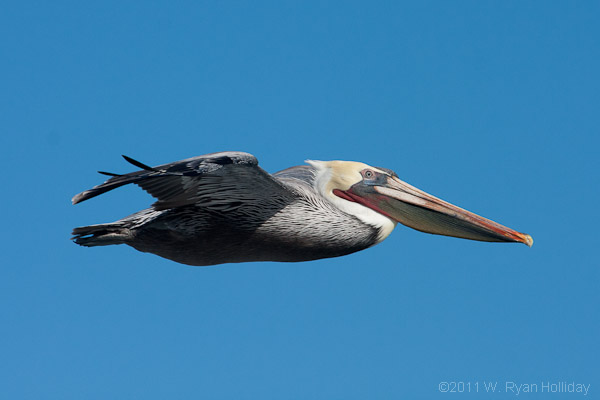
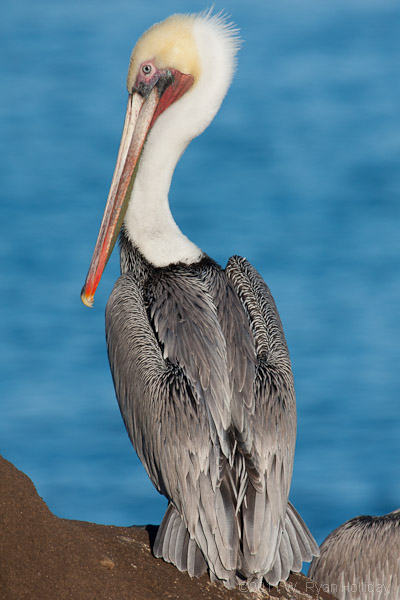
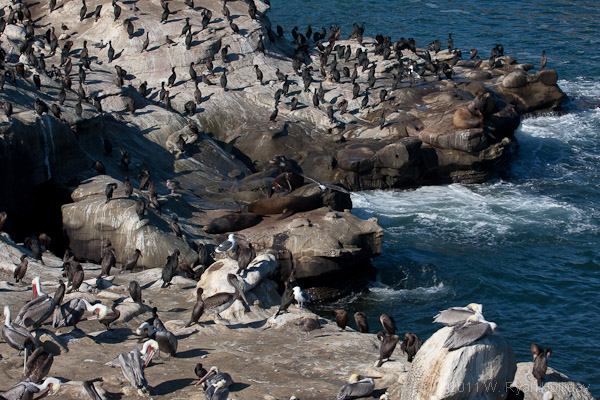
The girl and I were in San Diego for a wedding and a birthday, and with my new Marriott Rewards Super-Awesome status we scored a free room in La Jolla. Despite a forecast for a rainy weekend we woke up to clear skies Sunday morning and ventured out to find hundreds of pelicans on the cliffs. Other highlights included calling my shot on the hotel’s wheel of fortune (free parking, thank you much), too much food, and an appearance by Dorf himself at Audrey’s grandmother’s 95th birthday bash.

Brown Pelican, La Jolla

There’s probably a good reason why ages ago someone decided to call this bird a brown pelican, and that reason may be that they were colorblind.

Seabirds, La Jolla

Fun for the kids: how many sea lions are in this photo? If you said more than four, you counted a rock.

Brown Pelican, La Jolla

It takes many, many cups of coffee to make my eyes look like his.